

Some materials receive their colors from pigments. Mother-of-pearl does not.
Turn a piece of nacre beneath the light and white becomes pink, pink slips into green, and blue or violet appears from another angle. Chinese artisans learned long ago to work with this shifting natural light.
They cut and polished shell into thin pieces, shaped it into intricate forms, and carefully inlaid it into objects. From the relationship between shell, light, time and the human hand emerged Luodian (螺钿).
01 | Origins: A Craft with Roots in Ancient China
The history of Luodian reaches deep into ancient China. The Palace Museum notes that lacquer objects inlaid with shell elements have been excavated from Western Zhou tombs in Shaanxi, Henan and Beijing; some scholars regard these as an early source of the later Luodian tradition. The National Museum of China likewise notes that the earliest surviving Luodian objects known in China date to the Western Zhou period. [1] [2]
This matters because Luodian was never simply a decorative fashion. It grew from a long Chinese tradition of placing luminous natural materials against dark surfaces so that reflected light became part of the image.
02 | Tang Dynasty: Mother-of-Pearl and the Art of the Mirror
By the Tang dynasty, mother-of-pearl inlay had reached a highly sophisticated level. A celebrated example is the Flower-and-Bird Figure Mother-of-Pearl Bronze Mirror in the National Museum of China, dated to 756 CE. The museum describes thin shell pieces adhered to the back of the bronze mirror with lacquer and then polished and engraved into detailed figures, birds, plants and landscape forms. [2]
This object photograph belongs to the National Museum of China; because its reuse terms are not explicitly open, we link to the collection record rather than reproduce the photograph here — Flower-and-Bird Figure Mother-of-Pearl Bronze Mirror, Tang dynasty, 756 CE.
03 | Song, Yuan and Ming: Thinner Shell, Finer Images
The Palace Museum’s history of the technique notes that Luodian became more widespread during the Song dynasty, while thin-shell or “soft” Luodian is generally understood to have developed strongly in this period. In the Yuan and Ming periods, shell varieties became richer and workmanship increasingly refined, often combined with painted lacquer, gold, silver and other decorative methods. [1]
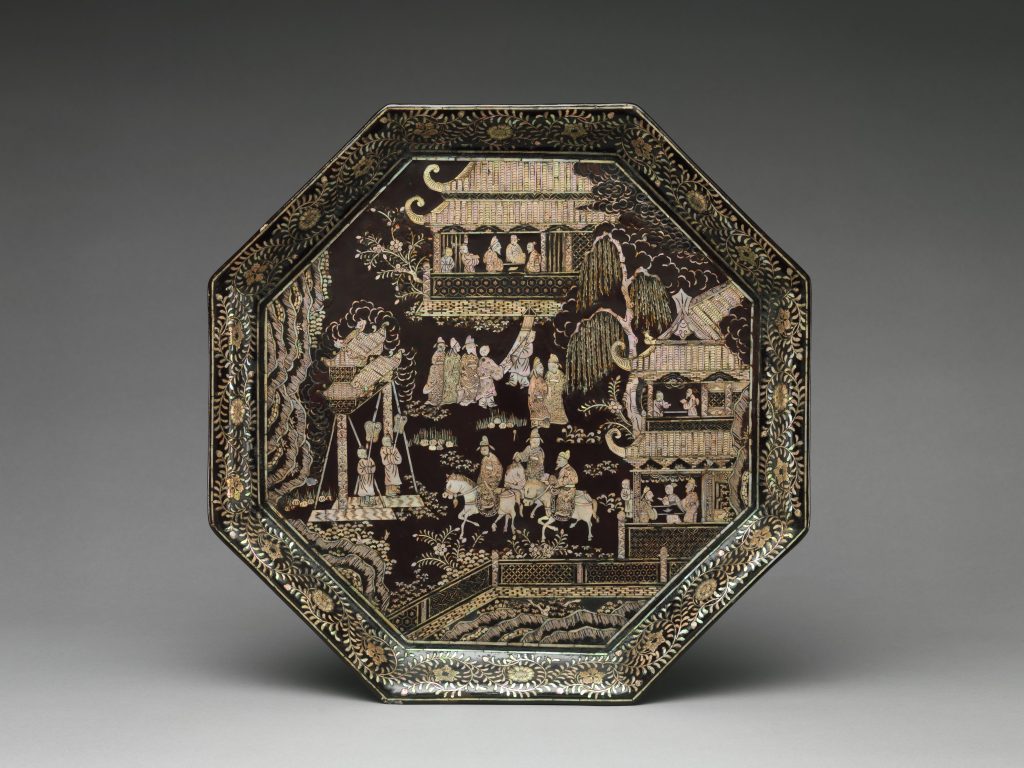
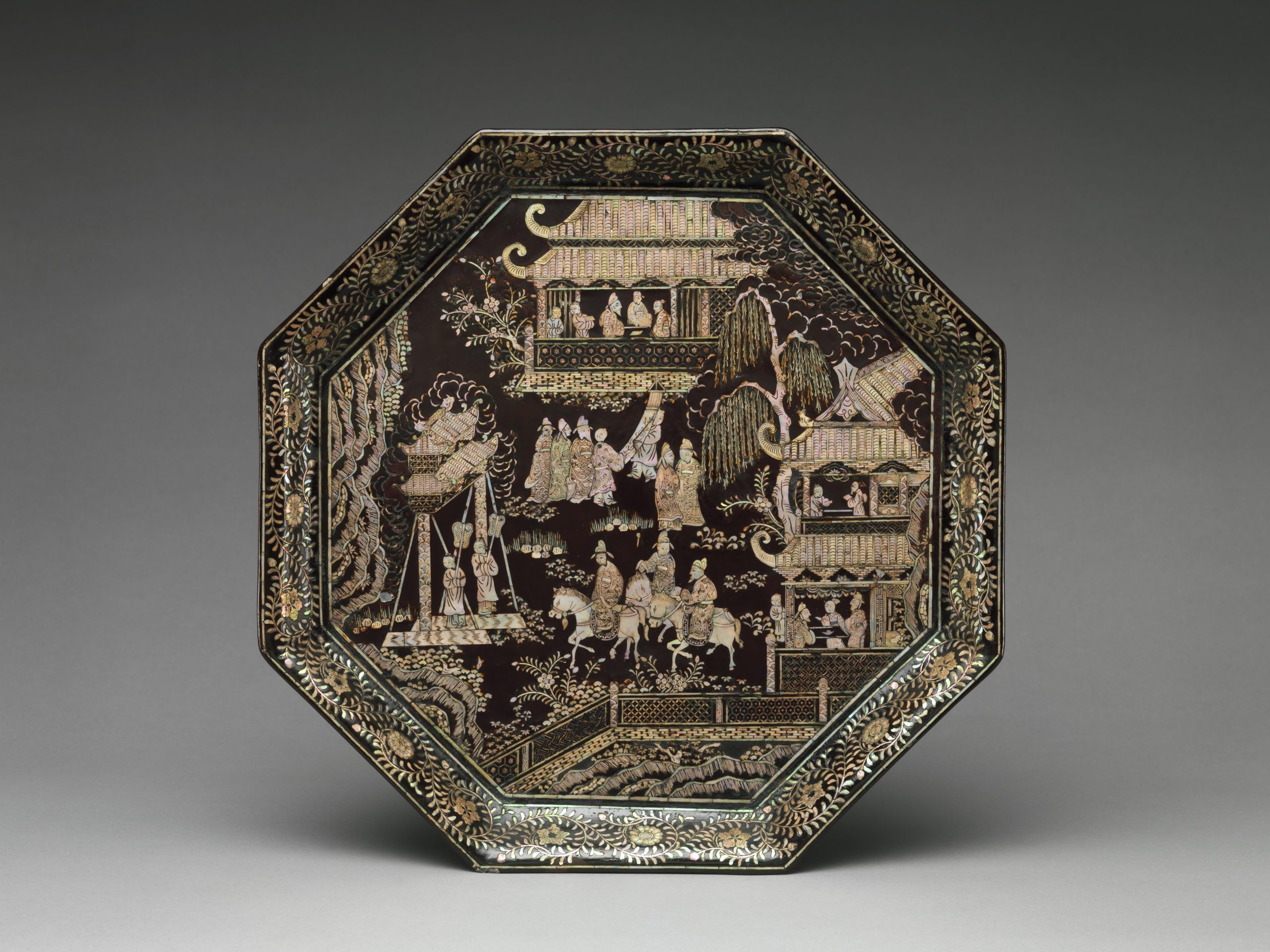
A Yuan-dynasty tray with figures in a landscape, preserved in the Metropolitan Museum of Art and released as an open-access image, shows how Luodian could function almost like painting: architecture, figures and landscape are built from minute pieces of luminous shell.
04 | Ming Dynasty: Luodian as Painting in Light
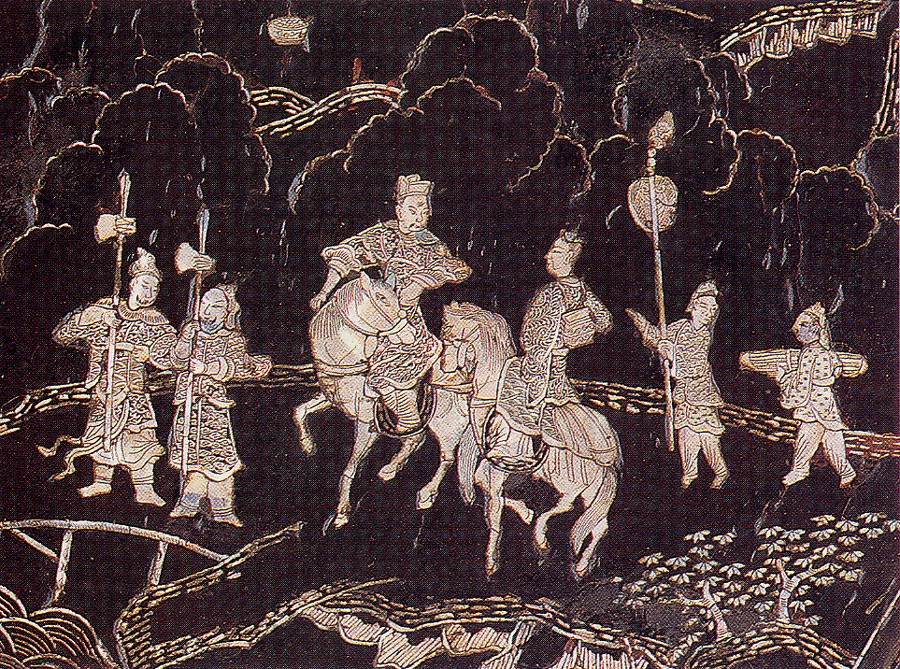
Ming Luodian demonstrates just how pictorial the medium could become. The Palace Museum describes Ming works ranging from small trays to large furniture, while surviving museum objects show mother-of-pearl used to construct complex scenes with scholars, buildings, gardens, clouds and plants. [1] [3]
Large furniture could also carry Luodian. The Palace Museum’s Ming black-lacquer table with cloud-and-dragon designs is inlaid throughout with mother-of-pearl and bears a Wanli reign mark. The museum identifies it as a representative example of Ming hard-shell Luodian lacquerware. [3]
05 | Qing Dynasty: Delicacy, Color and New Forms
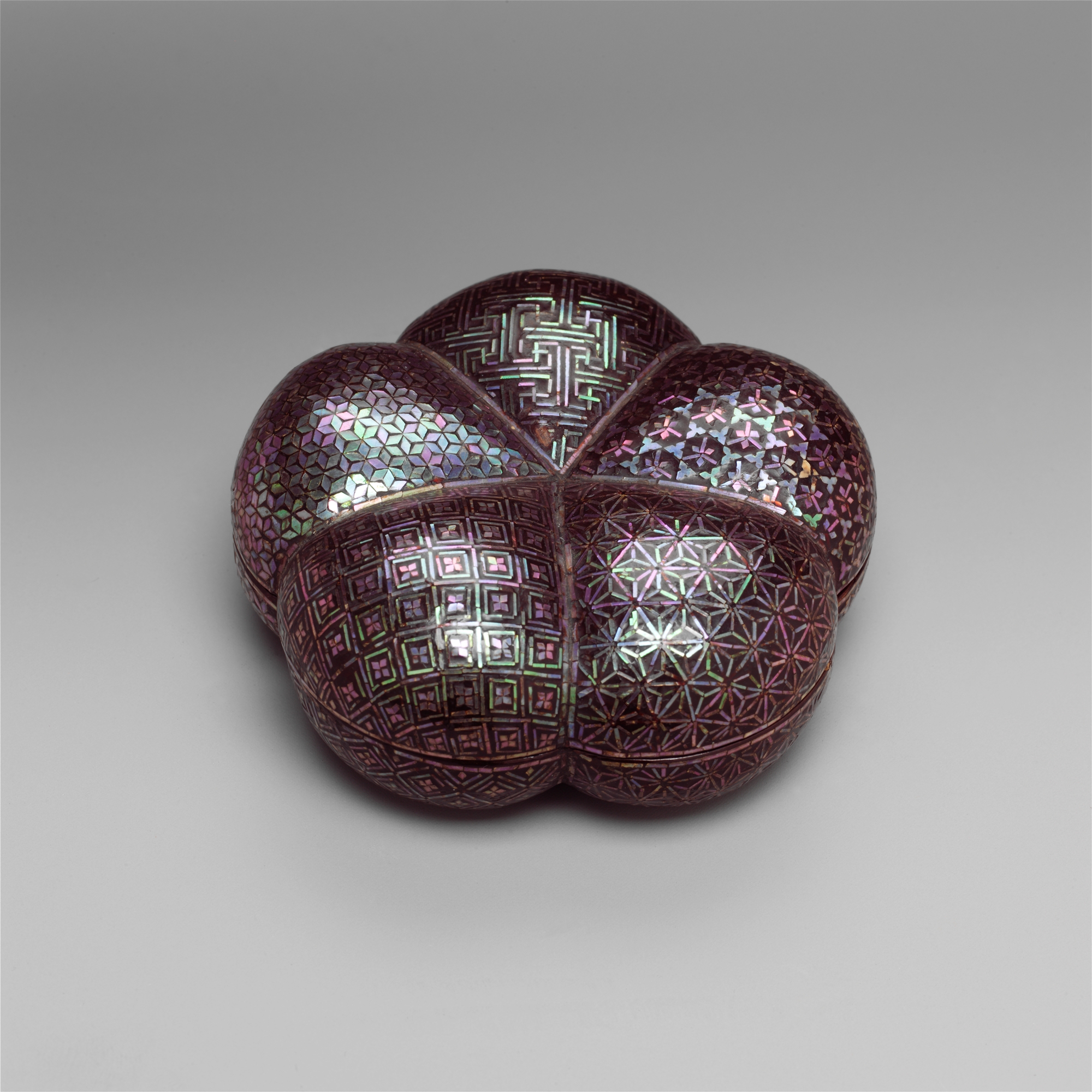
In the Qing period, thin-shell Luodian became increasingly delicate and could be applied to a wider range of materials and objects. The Palace Museum notes that shell could appear alongside precious stones and other inlay materials, while surviving objects demonstrate both highly pictorial scenes and striking geometric abstraction. [1]
Another remarkable Qing example in the Palace Museum is a black-lacquer box decorated with thin mother-of-pearl, gold and silver pieces to create a “Hundred Boys” scene. The museum describes shell sheets as thin as paper and praises the precision of their cutting and assembly. [4]
06 | How Luodian Is Made
Luodian is not simply shell glued onto an object. Exact methods vary by workshop and period, but the core process involves selecting shell for its natural color and luster, separating and thinning it, cutting it into precise forms, arranging the composition, setting the pieces into or onto lacquer or wood, and repeatedly finishing and polishing the surface.
Shell → Selection → Thinning → Cutting → Composition → Inlay → Lacquer / Finishing → Polishing → Light
The most important “pigment” is therefore not pigment at all. It is the structure of the shell itself, activated by light.
07 | From Mirrors and Lacquer Boxes to Furniture and Daily Life
Historical Luodian appeared on mirrors, trays, boxes, screens, tables, furniture, scholarly objects and many other forms. This breadth is important for understanding the craft today: Luodian is not one fixed motif, and it is not limited to one type of antique.
It is better understood as a material language: shell as color, the object as canvas, and light as an active part of the design.
08 | Why Luodian Still Matters
Natural shell resists perfect repetition. Each fragment has its own structure; each angle of light produces a slightly different effect; and hand cutting and placement introduce further variation. This makes Luodian especially meaningful in an era of mass production and increasingly effortless digital replication.
Its value lies not only in rarity or age, but in the encounter between natural material, skilled making and changing light.
09 | Nacre Cosmos: From Heritage to a Contemporary Universe
Nacre Cosmos does not need to reproduce the past literally. The deeper opportunity is to carry forward the principles that made Luodian extraordinary: natural shell, changing light, handwork, patience and imagination — and allow them to enter contemporary life.
Jewelry. Hair accessories. Collectible objects. Home pieces. Contemporary art. New materials and new manufacturing can coexist with shell, while visual language can travel from historical flowers, birds and landscapes toward nebulae, planets and the cosmos.
The shell remembers the sea.
The craft remembers time.
And light continues its journey.
References & Image Credits
- The Palace Museum — Luodian overview / history and technique
- National Museum of China — Flower-and-Bird Figure Mother-of-Pearl Bronze Mirror, Tang dynasty, 756 CE
- The Palace Museum — Black-lacquer table with mother-of-pearl cloud-and-dragon designs, Ming dynasty
- The Palace Museum — Black-lacquer box with mother-of-pearl and gold ‘Hundred Boys’ design, early Qing
Image credits. Tray with Figures in a Landscape (Yuan) — The Metropolitan Museum of Art, CC0, via Wikimedia Commons. Tray with Eighteen Scholars of the Tang (Ming, 15th century) — The Metropolitan Museum of Art, CC0, via Wikimedia Commons. Box with Geometric Designs (Qing, late 17th century) — The Metropolitan Museum of Art, CC0, via Wikimedia Commons.