

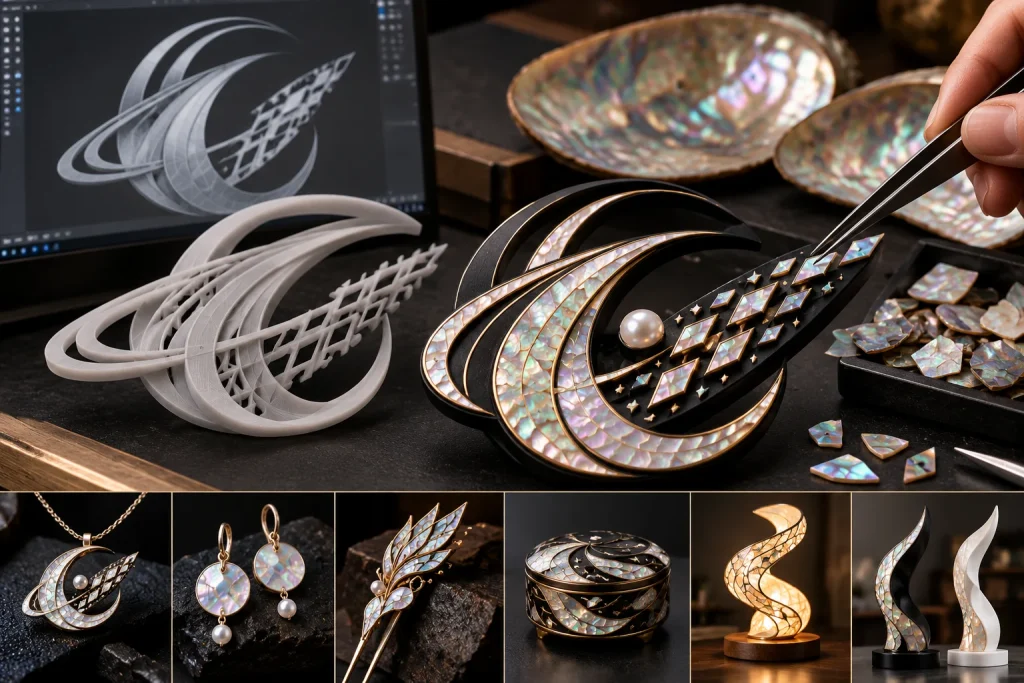
Ancient light. New form.
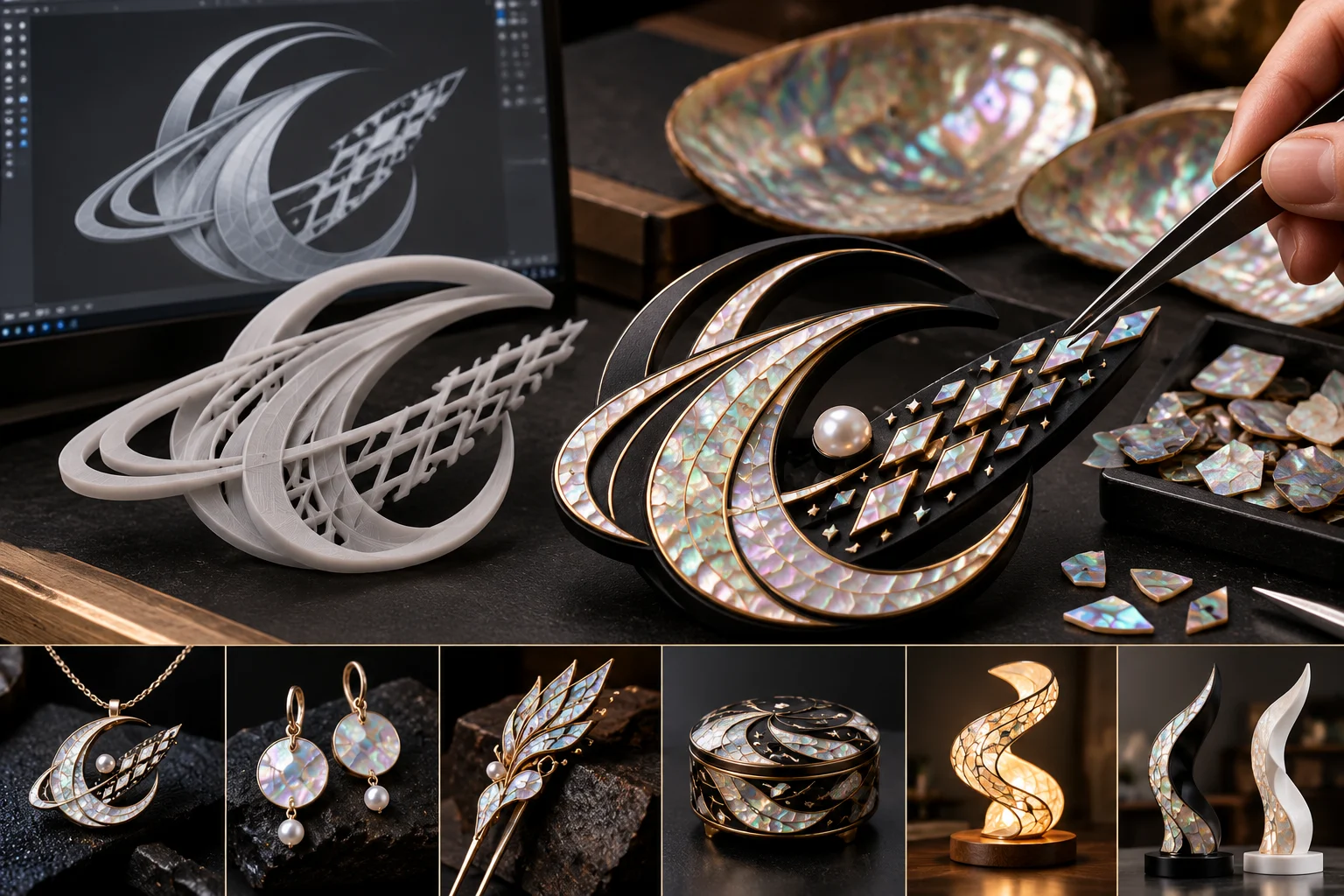
For thousands of years, mother-of-pearl has moved from one object to another: mirrors, lacquerware, boxes, furniture, personal accessories and decorative objects. In China, the inlay tradition is known as Luodian (螺钿)—the art of cutting luminous shell into carefully shaped pieces and setting them into a surface.
Every era has found a new vessel for this shifting light. Today, digital modeling and 3D printing offer another possibility: not replacing Luodian, but creating new structures for natural nacre and hand inlay.
That distinction matters. The future of craft does not have to mean printing an imitation of mother-of-pearl. It can mean using contemporary tools to make forms that were once difficult to produce, then allowing real shell and human judgment to complete the work.
What Is Luodian?
Luodian is a Chinese decorative inlay tradition that uses thin pieces of shell or mother-of-pearl on surfaces such as lacquer, wood and, historically, other objects. The material is valued for iridescence: its appearance changes with light and viewing angle. The craft has a long history in China and continues to be adapted for contemporary jewelry, accessories and decorative art.
Why 3D Printing?
3D printing changes the geometry available to a designer. Instead of beginning only with a flat panel, box or conventional jewelry setting, a designer can develop curved, hollow, lattice-like or parametric structures in a digital model. Recesses for shell can be planned as part of the object itself.
There is already contemporary jewelry practice combining 3D printing with traditional mother-of-pearl inlay. This suggests a useful model for innovation: digital fabrication can create the structure, while natural shell and craft remain visible rather than being simulated away.
Not “Fake Nacre”: A New Skeleton for Real Shell
For Nacre Cosmos, the more interesting direction is not to print rainbow plastic that merely resembles shell. It is to separate the roles of technology and material.
3D printing can create the skeleton: curves, settings, channels, lightweight frameworks and repeatable structural parts. Natural mother-of-pearl can provide the light: individually selected pieces whose color, grain and reflection can never be perfectly identical. The final fitting, orientation and finishing can remain a human decision.
Designing Around the Shell
Traditional inlay often begins with a motif and then cuts shell to fit it. Digital design makes the reverse approach easier to explore. A particular shell fragment can be photographed or scanned, its outline brought into a model, and the surrounding object designed around that piece.
That changes the relationship between material and product. The shell is no longer only decoration applied at the end; it can influence the form from the beginning.
Six Applications for 3D Printing + Luodian
1. Jewelry
Pendants, earrings, brooches, rings and cuffs can use curved or open frameworks that hold small pieces of natural nacre. This is one of the most practical areas for early experimentation because the objects are small and suitable for limited runs.
2. Hair Accessories and Fashion Details
Hairpins, clips, bag charms and wearable ornaments can combine lightweight printed structures with hand-set shell. Small batches also make it possible to test multiple forms without committing to large tooling runs.
3. Collectible Objects
Numbered tokens, miniature sculptures, keepsake objects and Nacre Tales-style collectibles can combine digital geometry, storytelling and individual shell patterns, making each piece visibly different.
4. Lighting and Home Objects
Mother-of-pearl is especially compelling around light. Printed lattices, curved frames and sculptural lamp forms could become carriers for nacre details, allowing reflection and translucency to become part of the experience.
5. Art and Spatial Objects
Parametric curves, orbital structures, spirals and complex surfaces can become frameworks for shell-based art objects. Here, 3D printing is useful not as a visual gimmick but as a way to manufacture geometry that is difficult to make conventionally.
6. Personalization
Names, dates, constellations, symbolic patterns or custom silhouettes can be integrated into a digital model before fabrication. Personalization can therefore change the structure itself—not simply add engraving after production.
Why Luodian Belongs in a Cosmic Visual Language
Mother-of-pearl rarely appears as a single fixed color. Blues, greens, pinks, violet and silver-white can emerge and disappear as the object moves. That optical instability makes nacre unusually compatible with imagery of nebulae, moonlight and planetary motion.
3D printing, meanwhile, is naturally suited to orbital curves, spirals, lattices and spatial structures. Together, the two can create a contemporary Luodian vocabulary built around galaxies, lunar phases, trajectories and light—without abandoning the natural shell that gives the craft its identity.
Technology Should Expand Craft, Not Erase It
AI can generate patterns. Algorithms can generate structures. A printer can fabricate complex geometry. But a natural shell fragment still asks for judgment: Which side catches the best light? Which direction reveals the strongest color? Where should it sit in the composition?
That is why the most meaningful future is not “technology replaces craft.” It is technology creating new possibilities for craft.
What Meaningful Innovation Looks Like
Adding the phrase “3D printed” to a product does not automatically make it innovative. A stronger test is whether the technology allows the craft to do something it could not easily do before: enter more complex curves, support individualized structures, combine parametric design with natural material, or reach new categories of jewelry, objects and interiors.
When technology changes the possibilities of the craft—while preserving the material intelligence and handwork that make it valuable—it becomes more than a novelty.
Nacre Cosmos: Finding New Vessels for Ancient Light
We do not know exactly what Luodian will look like decades from now. That uncertainty is part of its beauty. Crafts survive not only because people preserve their past, but because new generations find reasons to use them again.
Nacre Cosmos explores a simple question: if this light has traveled through objects for thousands of years, what should carry it next?
Ancient Light. New Form.
FAQ
What is Luodian?
Luodian (螺钿) is a Chinese decorative craft that uses pieces of shell or mother-of-pearl as inlay, often on lacquer or wood. The shell is cut, fitted and finished so its natural iridescence becomes part of the surface design.
Can mother-of-pearl be combined with 3D printing?
Yes. A practical approach is to use 3D printing for the structural body or setting and use real mother-of-pearl as an inlay material. Contemporary jewelry designers have already explored combinations of 3D printing and traditional mother-of-pearl craftsmanship.
Does 3D printing replace hand inlay?
It does not have to. In the approach described here, printing creates the carrier or geometry, while shell selection, orientation, fitting, inlay and finishing can remain craft processes.
Why use natural mother-of-pearl instead of printing an iridescent imitation?
Natural nacre has variation in color, grain and reflection that makes each piece distinctive. Using real shell keeps the material character of Luodian visible while digital fabrication expands the forms that can carry it.
What products could use modern Luodian?
Potential applications include jewelry, hair accessories, collectible objects, boxes, lighting, home objects and sculptural art. The best early products are likely to be small objects where limited production and hand finishing are practical.
Research Sources
- Google Search Central — Creating helpful, reliable, people-first content
- Google Search Central — Search appearance / image and structured-data guidance
- Jihyo Kim Jewellery — 3D Print Technology × Craftsmanship, including traditional mother-of-pearl inlay
- Gallery Japan — Mother-of-pearl inlay (Raden), materials and process
- KPL — Ancient Mother-of-Pearl Inlay Revived Through Modern Innovation in China (2026)