

Some materials receive their colors from pigments. Mother-of-pearl does not. Turn a piece of nacre beneath the light and white becomes pink, pink slips into green, and blue or violet appears from another angle. For centuries, Chinese artisans have transformed this shifting natural light into images, patterns, and objects through a craft known as Luodian (螺钿).
Luodian is a traditional Chinese mother-of-pearl inlay technique in which pieces of shell are cut, shaped, and set into surfaces such as lacquer or wood. Its history reaches back roughly three thousand years, while surviving museum objects show how the craft evolved from early shell inlay to highly sophisticated Tang mirrors and later lacquerware.
01 | What Is Luodian?
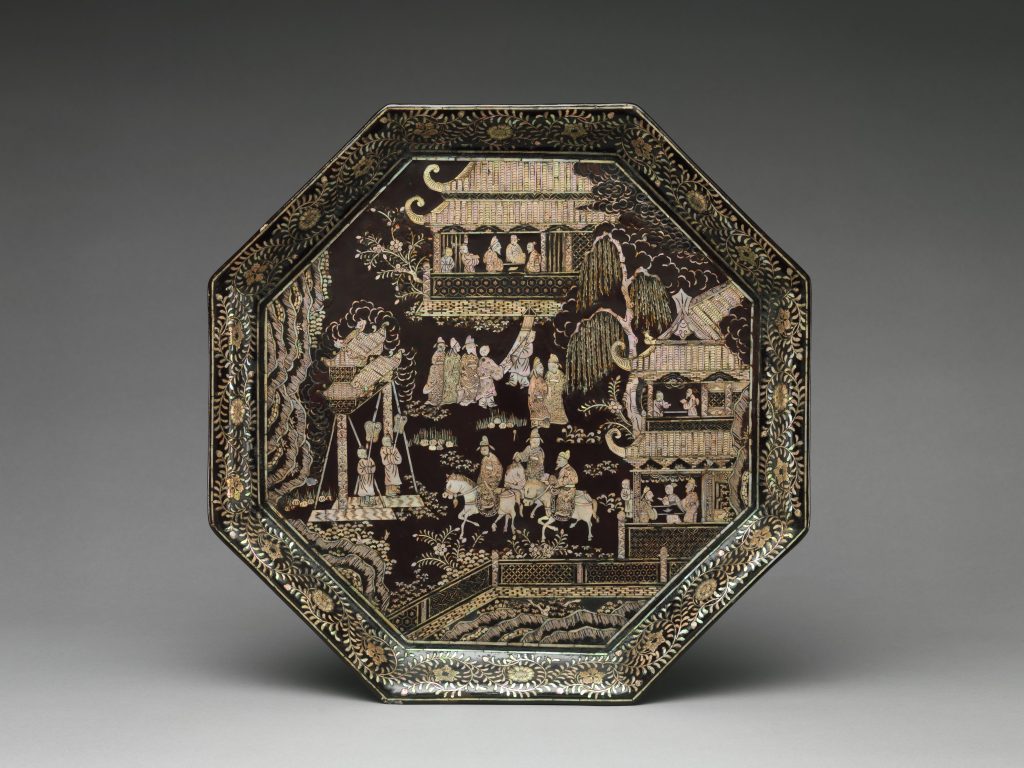
Luodian is best understood as a material language built from shell and light. The Palace Museum describes the technique as processing shells from mollusks into pieces, then cutting and assembling them into motifs such as plants, figures, birds, and animals before inlaying them into lacquer, wood, and other surfaces.
For an international audience, the closest familiar phrase is mother-of-pearl inlay. But Luodian is more specific than a generic decorative use of nacre: it refers to a long Chinese craft tradition with its own materials, techniques, historical styles, and visual vocabulary.
02 | Ancient Roots: A Craft Nearly 3,000 Years Old
The roots of Chinese Luodian reach deep into antiquity. The Palace Museum notes that lacquer objects with shell elements have been excavated from Western Zhou tombs in Shaanxi, Henan, and Beijing, and some scholars regard these finds as an early source of the later Luodian tradition.
This long history matters. Mother-of-pearl inlay in China was not a short-lived decorative fashion. It became a recurring way to place luminous natural material against darker surfaces so that changing light could become part of the design itself.
03 | Tang Dynasty: When Mother-of-Pearl Inlay Became Spectacular
By the Tang dynasty (618–907), Chinese mother-of-pearl inlay had reached a remarkable level of sophistication. The National Museum of China includes a Tang bronze mirror inlaid with mother-of-pearl among its collection highlights, demonstrating how shell could transform the back of a functional object into a luminous decorative surface.
Tang-period Luodian is especially important because the craft could combine shell, lacquer, metal, engraving, and complex imagery. Mirrors became more than reflective tools: their backs could become miniature worlds of figures, birds, plants, landscapes, and brilliant nacre.
04 | Song to Qing: Thinner Shell, Finer Images, New Surfaces
The craft continued to evolve. The Palace Museum notes that Luodian became widespread during the Song dynasty, when thinner shell techniques developed strongly. In the Yuan and Ming periods, artisans used a richer variety of shells and increasingly refined methods, sometimes combining mother-of-pearl with painted lacquer, gold, silver, and other decorative techniques.
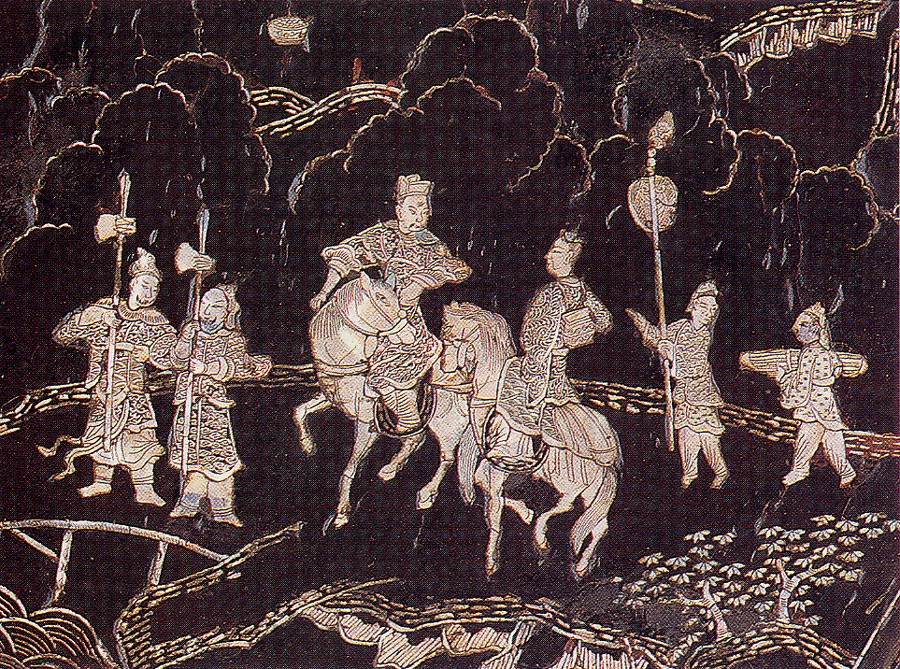
By the seventeenth century, Luodian had reached a high point of technical refinement. In the Qing dynasty, thin-shell work became increasingly delicate and appeared on a broader range of materials and objects. Mother-of-pearl could also be combined with other precious inlays rather than used alone.
05 | How Is Chinese Luodian Made?
Exact methods vary by period and workshop, but the essential idea remains consistent: artisans select shell for its color and luster, thin or prepare it, cut it into precise forms, arrange the composition, set the pieces into or onto the object, and finish and polish the surface.
Shell → Selection → Thinning → Cutting → Composition → Inlay → Finishing → Polishing → Light
The most important “pigment” is therefore not pigment at all. It is the structure of the shell itself. Nacre interacts with light to create iridescent color, so the appearance of a Luodian object changes as the viewer, object, or light source moves.
06 | Where Was Luodian Used?
Historical Luodian was not limited to one object type. It appeared on mirrors, trays, boxes, screens, tables, furniture, scholarly objects, clocks, and other decorative or functional forms. This range is useful when thinking about the craft today: Luodian is not a single motif and it does not belong only to antique lacquer boxes.
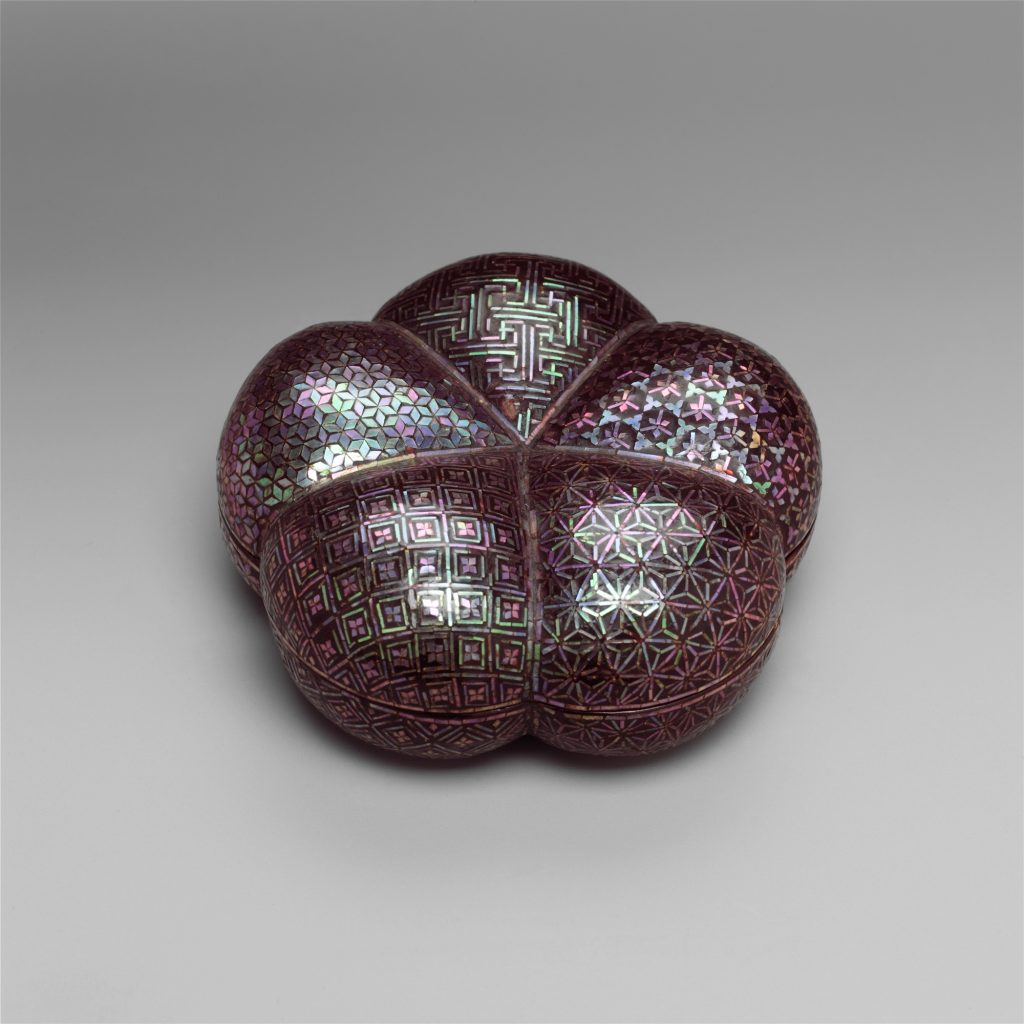
A better way to understand it is this: shell becomes color, the object becomes canvas, and light becomes an active part of the composition.
07 | Why Does Mother-of-Pearl Change Color?
The shifting color that makes Luodian so distinctive comes from the layered microstructure of nacre. Light interacts with these layers and produces iridescent effects that vary with angle. That is why a shell fragment may appear white from one direction and reveal pink, green, blue, or violet from another.
This is also why photographs never fully capture a Luodian object. Its visual character is partly temporal: it changes as you move.
08 | Why Luodian Still Matters in the Age of Mass Production
Natural shell resists perfect repetition. Each fragment has its own structure and color; each viewing angle creates a slightly different effect; and hand cutting and placement introduce further variation. In an era of mass production and effortless digital replication, those differences become meaningful rather than inconvenient.
The value of Luodian is therefore not only its age or rarity. It lies in the encounter between natural material, skilled making, cultural memory, and changing light.
09 | From Heritage Craft to Contemporary Design
Keeping Luodian alive does not require reproducing historical objects forever. The deeper opportunity is to preserve what makes the craft distinctive—real shell, changing light, handwork, precision, and imagination—while allowing it to enter contemporary life.
Jewelry, hair accessories, collectible objects, home pieces, contemporary art, and new manufacturing methods can all become new carriers for mother-of-pearl inlay. Historical flowers, birds, landscapes, and scholarly scenes can coexist with new visual languages: abstraction, geometry, nebulae, planets, and the cosmos.
For one direction we are exploring, read 3D printing and Luodian.
10 | Nacre Cosmos: Letting Ancient Light Travel Forward
At Nacre Cosmos, we see Luodian not as a style frozen in the past, but as a living material tradition. Our interest begins with the same thing that fascinated craftspeople centuries ago: a fragment of shell that changes whenever light touches it.
The shell remembers the sea.
The craft remembers time.
And light continues its journey.
FAQ: Chinese Luodian and Mother-of-Pearl Inlay
What does Luodian mean?
Luodian (螺钿) is a Chinese decorative inlay technique that uses processed shell, including mother-of-pearl, to create patterns and images on surfaces such as lacquer and wood.
How old is Chinese Luodian?
Its roots can be traced to shell-inlaid lacquer objects associated with the Western Zhou period, giving the tradition a history of roughly three thousand years.
Is Luodian the same as mother-of-pearl inlay?
Mother-of-pearl inlay is the broad English description. Luodian refers specifically to the Chinese craft tradition and its historical techniques and styles.
What objects were decorated with Luodian?
Historical examples include mirrors, trays, boxes, screens, furniture, scholarly objects, clocks, and other decorative or functional pieces.
Why does Luodian appear to change color?
The nacre in shell has a layered microstructure that interacts with light, creating iridescent colors that shift with viewing angle.
Is Luodian still relevant today?
Yes. Its core material and hand skills can be applied to contemporary jewelry, accessories, interiors, collectible design, art, and new manufacturing approaches without simply copying historical forms.
Sources
- The Palace Museum — The Mother-of-Pearl Inlays of China / Luodian: history, materials, period development and technique
- National Museum of China — Tang dynasty collection highlights, including a bronze mirror inlaid with mother-of-pearl
- Google Search Central — Creating helpful, reliable, people-first content
Image note: the museum objects shown here are open-access photographs from The Metropolitan Museum of Art (CC0). Photographs whose reuse terms are not explicitly open are linked rather than reproduced.